
A Practical Approach to Choir Audio:
Updated: Apr 27
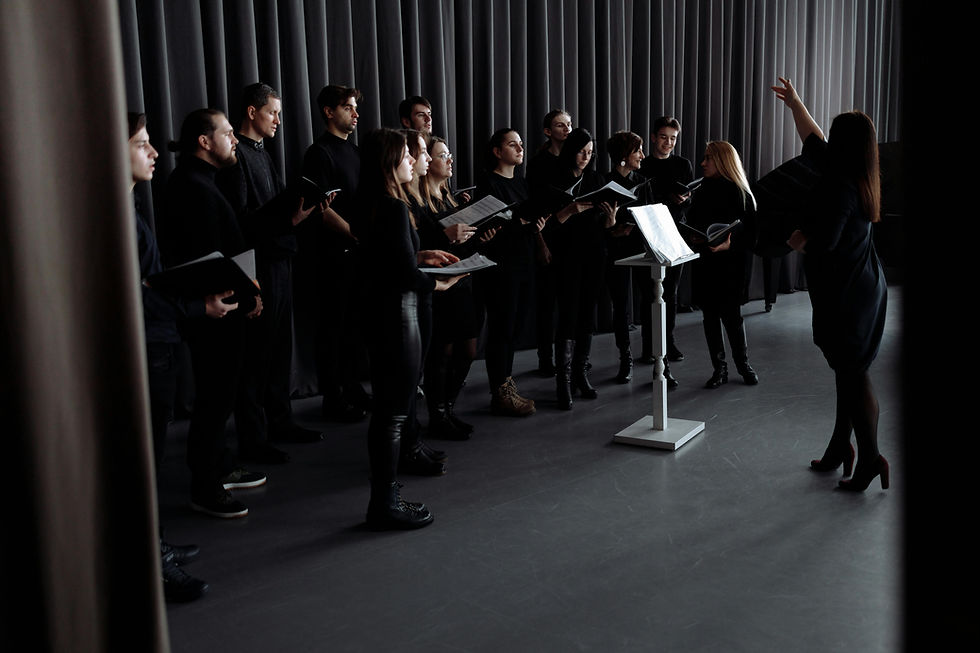
At Sapphire, we’re often brought in when systems are technically working, but not delivering the result people expect.
That’s a common challenge with choir audio.
Too many microphones, inconsistent coverage, and a sound that feels disconnected instead of unified. What should feel natural and musical ends up sounding complicated and uneven.
So the goal is simple: make it sound natural, make it consistent, and make it easy to operate.

Project Intent
The objective with choir audio is straightforward:
Capture a natural, blended choir sound
Maintain consistency between in-room and livestream audio
Reduce system complexity for volunteer operators
Minimize setup, adjustment, and troubleshooting
No over-complication. No constant tweaking. Just a system that works.
The Approach
Rather than focusing on individual voices, the system is designed to capture the choir as a cohesive whole.
Single Stereo Microphone (Simple, Natural)

Using a stereo microphone like the Shure VP88 allows the choir to be captured as a unified group.
This approach:
Preserves natural blend and timing
Captures width and spatial image
Reduces phase and balance issues
Keeps operation simple
Instead of managing multiple inputs, the system relies on proper placement and a single, well-defined pickup.
Distributed Microphones

For larger choirs or wider layouts, distributed microphones like the Audio-Technica U853 can provide more even coverage.
This approach is better suited for:
Larger ensembles
Wide or deep stage layouts
Situations where reinforcement is the priority
That said, more microphones introduce more complexity, so they’re used only when necessary.
Placement Matters

Even the right microphone won’t perform well if it’s placed poorly.
A simple guideline:
Approximately 2 feet in front of the choir
Approximately 2 feet above the tallest row
Small adjustments can significantly impact clarity, balance, and overall sound quality.
The Result

When done correctly, the difference is immediate.
The choir sounds cohesive instead of fragmented
Levels remain consistent week to week
The system becomes easier to operate
Both in-room and livestream audio improve
In a recent implementation, Sapphire helped Shepherd of the Valley Lutheran Church (Langley, BC), simplify their approach, resulting in a noticeably more natural and consistent sound, with far less effort required from the team.
Why This Approach Works
In choir environments, more equipment doesn’t mean better results.
We design systems that:
Prioritize natural sound over control-heavy setups
Reduce the number of variables
Improve consistency for volunteer operators
Focus on placement and approach, not just gear
Because the best system isn’t the most complex, it’s the one that sounds right every time.
Looking Ahead
Choir audio isn’t about adding more microphones, it’s about choosing the right approach.
As systems evolve, simplicity and consistency become even more important, especially in volunteer-driven environments.
If your choir isn’t translating clearly, the issue may not be your equipment.
It may be your setup.
Need help improving your choir audio?
Talk to the team at Sapphire, we’ll help you build something that just works.

